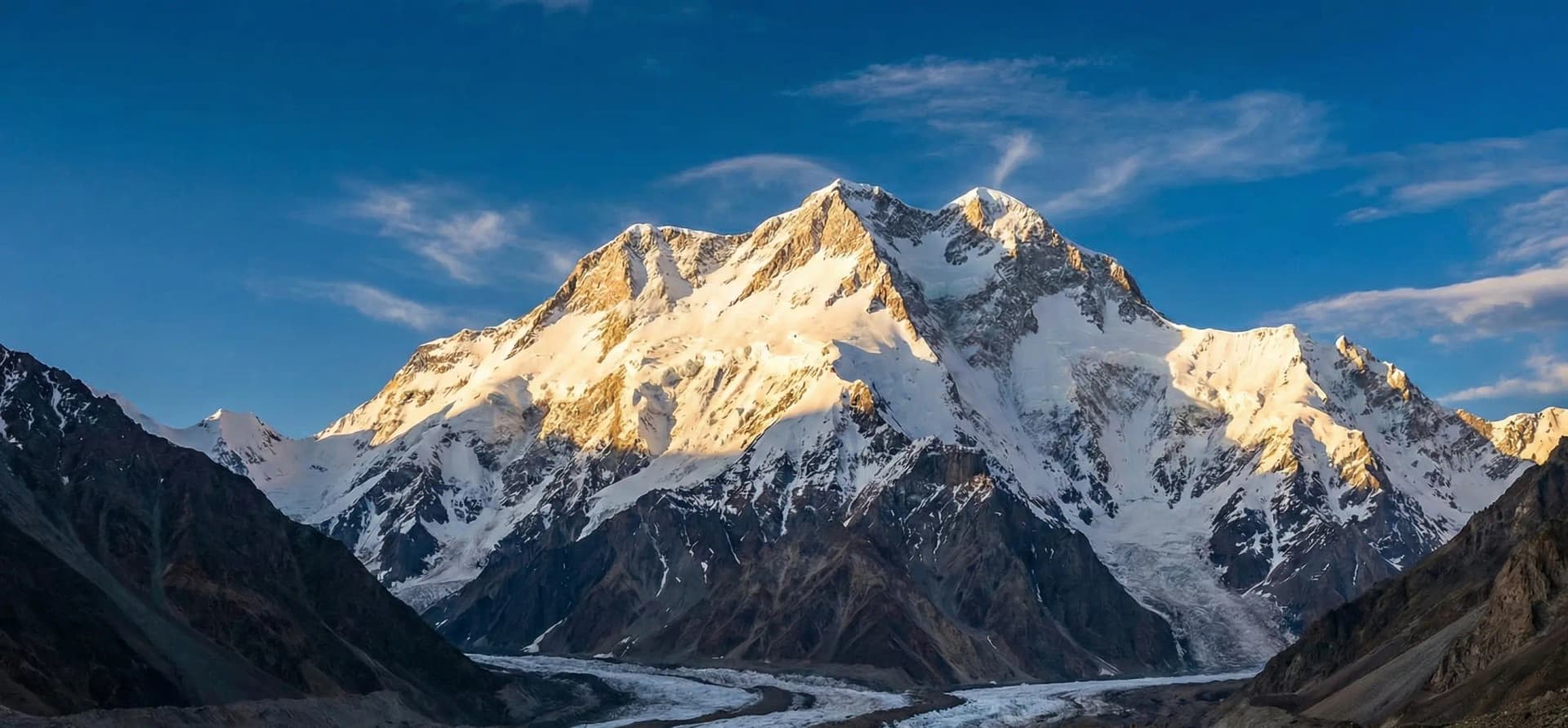
Broad Peak (8,051m)
Falchan Kangri — The Wide Giant
The world's 12th highest mountain and K2's majestic neighbour. Famous for its broad, sprawling summit ridge and its pioneering first ascent without oxygen — Broad Peak is where alpine-style climbing on 8,000m peaks was born.
12th Highest Peak
K2's MajesticNeighbour
Broad Peak rises to 8,051 metres (26,414 ft) in the central Karakoram, just 8 kilometres southeast of K2. Its name tells the story: this is a mountain defined by its extraordinary width, not its sharpness.
The summit ridge stretches nearly 2 kilometres above 7,800m — the longest and broadest of any 8,000-metre peak. This sprawling plateau, deep in the death zone, is both the mountain's signature feature and its greatest challenge. Climbers often spend 10–14 hours traversing this ridge on summit day, battling altitude, exhaustion, and exposure at every step.
Despite these challenges, Broad Peak holds a special place in mountaineering history. Its 1957 first ascent — by four Austrian climbers without supplemental oxygen and without high-altitude porters — was a radical departure from the siege-style expeditions of the era. This lightweight, alpine-style approach proved that 8,000m peaks could be climbed with small teams and minimal equipment, revolutionising high-altitude mountaineering.
Today, Broad Peak is considered one of the more accessible 8,000-metre peaks, with a fatality rate of approximately 5% — significantly lower than K2's 22–25%. It is frequently used as a warm-up or acclimatisation climb before K2 expeditions, and its base camp offers what many consider the finest view of K2 in existence. Consider reviewing our safety protocols for high-altitude trekking.
“The summit ridge goes on forever. Every step is a battle. You think you've arrived, and then you see another hour ahead of you.”
— Kurt Diemberger, First Ascent Team, 1957
Why Climbers ChooseBroad Peak
K2's Stunning Neighbour
Broad Peak Base Camp offers arguably the best view of K2 on Earth — the savage mountain rises just 8km to the northwest, dominating the skyline.
Gateway 8,000er
With a ~5% fatality rate and moderate technical difficulty, Broad Peak is often recommended as a first 8,000m peak or as acclimatisation before a K2 attempt.
Alpine-Style Heritage
The first ascent in 1957 — without oxygen or porters — set a revolutionary precedent for lightweight high-altitude mountaineering that influenced generations.
Concordia Access
The trek to Base Camp passes through Concordia, one of the most spectacular mountain amphitheatres on Earth, with four 8,000m peaks visible simultaneously.
The Names ofBroad Peak
Named by British explorer William Martin Conway in 1892 for the mountain's distinctive broad, flat summit ridge — the widest of any 8,000m peak.
The local Balti name, variously translated as "wide peak," "beautiful peak," or "broad mountain." Used by communities in the Hushe and Shigar valleys of Gilgit-Baltistan.
In the original Great Trigonometric Survey notation, Broad Peak was catalogued as "K3" — the third peak measured in the Karakoram range — immediately after K2. This designation is rarely used today.
Where Broad PeakStands
Location in the Karakoram
Broad Peak stands in the heart of the central Karakoram, in the Gilgit-Baltistan region of Pakistan. It lies approximately 8km southeast of K2, making them close neighbours along the Baltoro Glacier system. The mountain sits at coordinates 35°48\'38″N, 76°34\'06″E, near the China-Pakistan border. Its proximity to K2, Gasherbrum I, and Gasherbrum II makes the area the densest concentration of 8,000m peaks on Earth.
The Three Summits
Broad Peak's most distinctive feature is its long, flat summit ridge — giving the mountain its English name. The ridge connects three summits: the Main Summit (8,051m), the Central Summit (8,011m), and the North Summit (7,490m). The nearly 2km-long summit ridge above 7,800m is one of the highest and most exhausting plateaus on any mountain. Climbers often describe the final push as "endless" — walking at near-sea-level pace in the death zone.
Godwin-Austen Glacier
Broad Peak's base camp sits on the Godwin-Austen Glacier at approximately 4,960m (16,270 ft), sharing the glacier system with K2 Base Camp located just a few kilometres to the northwest. The approach trek follows the Baltoro Glacier from Askole (7–9 days), passing through Concordia — one of the most spectacular amphitheatres in mountaineering, where four 8,000m peaks dominate the skyline.
Geological Composition
Like its Karakoram neighbours, Broad Peak is composed of metamorphic and sedimentary rock — primarily gneiss, schist, and marble — formed when the Indian tectonic plate collided with the Eurasian plate approximately 50 million years ago. The relatively loose, friable rock on the West Spur creates persistent rockfall hazards, particularly in the afternoon when solar heating loosens stones from the upper walls.
Routes to theSummit
While the Normal Route is the most popular approach, Broad Peak offers several challenging alternatives for experienced mountaineers.
West Spur / Normal Route
West Face to Summit Ridge
The route of the first ascent and the standard approach used by the vast majority of climbers. It begins from Base Camp (4,960m) on the Godwin-Austen Glacier and ascends the broad West Spur through three established camps. Camp 1 (5,700m) sits on the lower spur, Camp 2 (6,400m) on a snow shelf, and Camp 3 (7,000–7,100m) on the upper slopes. The final push traverses the long, arduous summit ridge — a 3km snow plateau above 7,800m that is exhausting at altitude. Technical difficulties are moderate (PD+ to AD-), but the sheer length of the summit day and exposure make it a serious objective.
Southwest Face
Direct Southwest Face
A more direct line up Broad Peak's imposing southwest face. First climbed by Polish teams in the 1980s. The route involves steeper ice and mixed climbing (AI3–4, M4) on a 2,500m face, bypassing the long summit ridge approach. Less crowded but significantly more exposed to avalanche and rockfall danger. Requires advanced ice-climbing skills and alpine-style tactics.
North Ridge
From Xinjiang, China
Approaches from the Chinese/Xinjiang side, ascending the north ridge. Logistically complex due to the remote Chinese approach, permit difficulties, and limited infrastructure. The route involves sustained ridge climbing with mixed rock and ice sections. Very few ascents have been made from this side, and it remains one of the least-known approaches to any 8,000m peak.
Rocky Summit / Central Summit
Three Summits Traverse
Broad Peak has three distinct summits — the Main Summit (8,051m), Central Summit (8,011m), and North Summit (7,490m). A complete traverse of all three is considered one of the great challenges in Karakoram mountaineering. Only a handful of climbers have completed the full traverse, which requires sustained technical climbing at extreme altitude over multiple summit days.
Broad Peak'sGreatest Hazards
While more accessible than K2, Broad Peak presents serious objective dangers that demand respect and preparation.
The Summit Ridge (7,800–8,051m)
The defining challenge of Broad Peak. A nearly 3km-long ridge above 7,800m that must be traversed to reach the true summit. At extreme altitude, this can take 6–10 hours each way. Many climbers turn back from the "foresummit" (7,900m), mistakenly believing they've reached the top. Sudden weather changes on the exposed ridge have caused numerous tragedies — climbers caught in whiteouts with no shelter and no way to descend safely.
Serac Zone (6,800–7,200m)
Between Camp 2 and Camp 3, climbers must navigate beneath and around unstable ice seracs on Broad Peak's west face. These house-sized blocks of ice can collapse without warning, particularly during the warmer afternoon hours. The standard strategy is to pass through this zone during the early morning hours when temperatures are coldest and the ice is most stable.
The Col (7,800m)
The col (saddle) between the foresummit and the main summit is a critical decision point. Climbers reaching the col late in the day face an agonising choice: continue to the true summit (potentially 3–5 hours more) or turn back. The col is fully exposed to winds from both sides of the mountain, and many climbers have been caught here during sudden storms.
Lower West Spur Rockfall
The lower sections of the West Spur between Camp 1 and Camp 2 are prone to rockfall, especially in the afternoon. Loose gneiss and shale create constant danger as stones heated by morning sun break free and funnel down natural gullies. Helmet use is mandatory, and most teams climb this section before dawn.
Conditions onBroad Peak
Broad Peak benefits from slightly more stable weather than K2, but remains a serious 8,000m environment with extreme conditions.
No Confirmed Winter Ascent
Broad Peak remains one of the few 8,000m peaks without an indisputable winter ascent. The 2013 Polish attempt (March 5 — technically still winter by mountaineering definitions) ended in tragedy, and debate continues about whether the true summit was reached. Winter conditions on Broad Peak are particularly severe due to the exposed summit ridge, which offers no shelter from jet-stream winds exceeding 150 km/h.
Broad Peak vs. ItsKarakoram Neighbours
A History ofBold Ascents
From its first survey in 1892 to the modern era — Broad Peak's story is one of innovation, tragedy, and the relentless human drive to stand on top.
First Survey & Naming
British surveyor William Martin Conway led an expedition to the Baltoro Glacier region, becoming the first European to see Broad Peak up close. He named it "Broad Peak" for its distinctive flat, elongated summit ridge — unlike the sharp pyramids of neighbouring K2 and Gasherbrum. The local Balti name "Falchan Kangri" (meaning "wide peak" or "beautiful peak") was already in use among local communities.
First Attempt — German Expedition
Dr. Karl Herrligkoffer organised the first serious climbing attempt on Broad Peak. The team approached via the Baltoro Glacier and attempted the West Spur route. Despite reaching approximately 6,900m, the expedition was defeated by severe storms and deep-snow conditions. The attempt provided valuable reconnaissance of the mountain's western approaches.
First Ascent — Austrian Triumph
On 9 June 1957, Austrian climbers Fritz Wintersteller, Marcus Schmuck, Kurt Diemberger, and Hermann Buhl reached the summit via the West Spur / Normal Route — without supplemental oxygen and without high-altitude porters. This was a revolutionary "alpine-style" approach for an 8,000m peak. Hermann Buhl, who had famously soloed Nanga Parbat in 1953, tragically died just 18 days later when a cornice collapsed on nearby Chogolisa.
Second Ascent — Polish Team
A Polish expedition led by Janusz Ferenski placed climbers on the summit via the Normal Route — 18 years after the first ascent. The long gap between the first and second ascents demonstrated Broad Peak's considerable challenge despite its "accessible" reputation. Polish climbers Kazimierz Glazek and Janusz Kulis reached the top on 30 July.
First Solo & First Female Ascent
In a remarkable year, Polish climber Krzysztof Wielicki completed the first solo ascent of Broad Peak. That same season, Polish mountaineer Krystyna Palmowska became the first woman to summit Broad Peak, further cementing Poland's extraordinary legacy in Karakoram mountaineering.
Winter Attempts Begin
Polish climbers Adam Bielecki, Maciej Berbeka, Tomasz Kowalski, and Artur Małek claimed a winter ascent on 5 March. However, the ascent ended in tragedy — Berbeka and Kowalski died during the descent, and debate continues about whether the team actually reached the true summit or a fore-summit. The mountain has never been indisputably climbed in winter.
Record Season
The 2018 climbing season saw a record number of summits, with over 50 climbers reaching the top in a single season thanks to stable weather windows and improved logistics. Commercial expeditions became more common, bringing Broad Peak within the reach of experienced high-altitude trekkers.
Modern Era
Broad Peak continues to attract climbers as one of the more "accessible" 8,000m peaks, though it remains a serious mountaineering objective. Modern seasons typically see 40–80 summit attempts, with success rates around 25–35% depending on weather. The mountain is now commonly attempted as a warm-up or acclimatisation peak before K2 expeditions.
Frequently AskedQuestions
What you need to know about the 12th highest mountain.
Where does the name "Broad Peak" come from?+
Is Broad Peak easier to climb than K2?+
How long does the summit day take on Broad Peak?+
What is the "foresummit" on Broad Peak?+
Has Broad Peak been climbed in winter?+
Where is Broad Peak Base Camp?+
Can I trek to Broad Peak Base Camp without climbing?+
Begin Your Expedition
Ready to ClimbBroad Peak?
Our Askole-based team knows these mountains intimately. From Base Camp logistics to summit strategy — we'll plan every detail of your Broad Peak expedition with the care and local expertise that only a community-managed operator can provide.